
|
Dictionary of Technical Terms - K
A B
C D E F G
H I J K L
M
N O P Q R
S T U V W
X Y Z
Num
Kelvin.
Kilo. One thousand.
Kiloampere.
A Grass Valley Group digital video switcher with
layering and image manipulation capabilities.
A Grass Valley Group digital effects system.
Hardware capable of processing one layer of video
with all of the Kaleidoscope video features including 3-D
transformations and Kaleidoscope special effects (wipes, keys,
recursive effects, mosaics, etc.).
1. Also called key source or key cut. A signal that
can be used to electronically "cut a hole" in a video picture to
allow for insertion of other elements such as text or another video
image. The key signal is a switching or gating signal for
controlling a video mixer which switches or mixes between the
background video and the inserted element. 2. The composite effect
created by cutting a hole in one image and inserting another image
into the hole.
Simultaneous use of more than one key source and/or
fill in a single keyer.
A keyer feature that allows automatic removal of a
downstream key from air by pressing an appropriate crosspoint
pushbutton.
See key split.
A video switcher crosspoint bus used to select key
sources (hole cutters) and/or key fills. Signals available to the
key bus are typically the same sources and fills that are supplied
to the other switcher crosspoint buses plus additional external key
sources and fills.
A channel of a digital picture manipulator that is
used for manipulating key signals while the corresponding key fill
video is manipulated by another channel.
See clip or gain.
See key.
A device or circuit that produces border effects
around the edges of a key.
An electronic circuit that creates a control signal
to control a video multiplier based on selective information
contained in a video signal.
In key effects, the video signal that is said to
"fill the hole" cut in the background video by the key source.
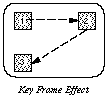
An effect that has been stored in memory, similar to
a snapshot photograph. Individual key frames can be strung together
to create an overall key frame effect, which is similar to
animation.
The memory space used to store a key frame effect as
you create or edit it.
An overall effect consisting of a series of effects
snapshots called key frames. When the overall effect is replayed,
the machine (switcher, DPM, etc.) automatically and gradually
dissolves from one key frame to the next. A process called
inbetweening defines what happens between key frames. The result is
a moving animation effect.
See key.
A luminance key mode that inverts the polarity of
the key source to allow dark areas of the source video to cut holes
in the background instead of bright areas. A chroma key mode that
inverts the foreground and background positions.
A video switcher feature that allows a key source to
be selected at the switcher and then sent to a digital picture
manipulator for manipulation. The manipulated key and fill video
are then returned to the switcher's keyer for keying ("flying" a
key) over background video.
See mask.
A Grass Valley Group effects memory storage system
that saves E-MEM effects onto a removable EEPROM shaped like a
key.
The memorized key clip, gain, and key type
selections for each key source.
A keyer feature that alternately fades a key in over
background video or fades it out.
Control functions on a keyer that permit alteration
of the key in some way, such as shadow, invert, mask, and edge
effects.
A function that determines which key appears on top
in video switching/keying systems having multiple keyers all on-air
at the same time.
See key breakaway.
The signal that is said to "cut a hole" in the
background scene for a key effect. This signal controls a video
mixer that switches between the background scene and the fill
video; thus, the key source determines the shape of the key
effect.
A video switcher key mode in which one key bus
button selects the hole cutter and a different key bus button
selects the fill video. Also called split key or key breakaway.
The key fill, key source, or both.
A specification rating method that gives a higher
factor to video disturbances that cause the most observable picture
degradation.
One thousand hertz.
A unit of measurement of data transmission speed
equalling one thousand baud. See baud.
One thousand twenty-four (1024) bytes (210).
Unit of measure of weight. One kilogram equals 2.20
pounds.
One thousand ohms.
GVG name for a switcher Mask Bus, which allows
signals from the wipe, key, and mask rectangle generators to
cumulatively modulate (modify) wipes, keys, or mattes. Allows users
to build custom key masks from a variety of sources.
A digital picture manipulator made by GVG.
An option to the GVG Kaleidoscope™ Digital
Picture Manipulator that provides such effects as page turns, page
rolls, ripples, slits, and spheres.
Kilovolt.
Kilovoltampere.
A B
C D E F G
H I J K L
M
N O P Q R
S T U V W
X Y Z
Num
Copyright © 2001 Grass Valley Group -
[email protected]
|