Key Features
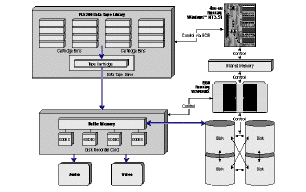
The PLS200 Profile® Library System is a robotic tape library that provides affordable mass storage for the Profile Professional Disk Recorder (PDR). The PLS200 consists of the Library Unit, with 1.6 terabytes (TB) of data storage, and the Profile Library System Software. An EISA SCSI card is included for insertion into the Profile. The PLS200 Profile Library System is a less expensive storage alternative than hard disks and is more reliable than videotape storage. Its automated operation makes it a superior solution for spot insertion, program playout, news archiving, backup, storage, and forwarding. The PLS200 is excellent for broadcast studios and video production facilities. The Data LibraryA data tape robotic library system is very much like a video cart machine. A computer controlled robotic arm retrieves a data tape cartridge from its bin and inserts it into a tape transport. The computer then instructs the transport to fast forward, rewind, play, or stop the tape — depending on where the desired segment is located on it. The PLS200 Library Unit consists of four 8 mm helical scan transports which operate at a data rate of 3 M bytes/second. The four transports are mounted in a small cabinet with 80 cartridge bins — each of which hold one 8 mm Advanced Metal Evaporated tape cartridge. Each cartridge holds 20 GB of data for a total storage capacity of 1.6 TB, providing up to 110 hours of play at 24 Mb/s. Average file access is less than ten seconds, with a worst case file retrieval time of 3 minutes. Cartridges can be partitioned for faster file access and easier replacement of individual spots. Single spots or programs can be stored on individual cartridges to simplify operation. The PLS200 uses industry proven, streaming tape technology to enhance reliability. The PLS200 Library System works only with a Profile PDR, which runs the PLS200 control software and serves as a real-time clip cache. The Library Unit cannot be attached directly to a network. The Profile Library System SoftwareThe PLS200 Profile Library System Software can either run directly on the PDR or on a remote computer connected to the PDR using an RS-422 or ethernet connection. The Profile Library System Software provides control of the PLS200's robotics and tape transports.
When a file is requested from the PLS200, the Profile PDR sends instructions to the robotic arm of the Library Unit, which selects the correct cartridge, loads it in a tape transport, and cues the tape to the right location. The file is then retrieved from the PLS200 and loaded onto the hard disk of the controlling Profile PDR for real-time playback. When a file is to be stored on tape in the PLS200, the Profile PDR determines which cartridge will be used, instructs the robotic arm to place the cartridge into a data transport, and then begins copying the file from the PDR hard disks to the cartridge.
EISA SCSI ConnectionThe EISA SCSI card plugs into the controlling Profile PDR to provide communication between the PDR and the PLS200. The card provides a SCSI-2 fast, wide, differential interface. The connection process is simple:
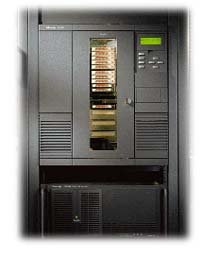
Tape PartitioningTape partitioning —logically dividing a tape into multiple sections— is especially useful for spot insertion in commercial broadcast applications. Material within a partition can be located more quickly and easily removed or replaced. In a non-partitioned tape, each new spot is added sequentially. When a thirty-second spot at the beginning of the tape is deleted, all the data from that spot forward must be re-recorded. The data must be copied to another source and then rewritten to the edited tape. In a partitioned tape, only the material in a particular partition must be rewritten. Since each spot can have its own partition, editing or replacing single spots becomes much faster and simpler. Consequently, the PLS200 provides an efficient, cost effective solution to managing commercial spot and short program inventories. Library OperationTeamed with the Profile PDR the PLS200 provides superior access to video and audio material for an entire facility. As well, its removable cartridges can be used to exchange compressed files between PDRs not linked by a network. Since it is cost-prohibitive to archive all spot and program material on disk, automated access to archives through a PLS200 increases the effective capacity of the entire system. Compared to the cost of storing video and audio on hard disk arrays, data tape storage is remarkably inexpensive. The PLS200 Profile Library System features a much smaller footprint, higher reliability, and easier maintenance than analog videotape archives. The Mean Cycles Between Failures rate of the PLS200 Library System is 750,000 cycles, which corresponds to 1,500,000 mean tape mounts. It features easy frontal access and the ability to mount in a standard 19 inch rack. Its small footprint, low cost, and superior reliability make the PLS200 a welcome addition to any busy facility. Intelligent design and simplified integration significantly reduce maintenance costs and increase overall system reliability. Note: Units delivered to customers have steel covers. |
|
 |